November 20, 2026 · Telegram Ban Service · 14 min read
Deepfake Telegram bots: how to report the bot, the channel and the rest
A deepfake Telegram bot is reported in two ways: the Report button inside the app, and an email with its t.me link sent to abuse@telegram.org. Telegram's moderators alone decide whether the bot, its channel or single posts come down. Report each part on its own, because removing the bot leaves the channel that advertises it untouched.
What is a deepfake Telegram bot, and who decides if it goes?
A deepfake Telegram bot is an automated account that turns an ordinary photo of a real person into a fake sexual image. You send it a picture in a normal chat. It answers with a generated picture.
The same tool hides behind many labels. Ads call it a Telegram nudify bot, a Telegram undress bot or a Telegram AI deepfake photo editor. Some posts spell the word in two parts, so a deep fake Telegram bot or a deep fake AI Telegram editor is the same product. Telegram's rules use none of these names. When you report one, describe what it does to real people rather than what it calls itself.
Telegram Ban Service is an independent content reporting and takedown service that prepares cases against Telegram bots, channels and groups breaking Telegram's published rules. It collects the links and the proof and submits them via the report channels Telegram itself provides. Telegram's moderators decide every removal. No one outside Telegram can delete a bot, a channel or a single post.
Bot, channel or group: which part of the operation do you report?
Report every part that does a separate job, because Telegram judges and removes each one on its own.
A deepfake operation on Telegram has several moving parts. The bot makes the images. A deepfake Telegram channel advertises the bot, posts samples and shares the next username when the old one disappears. A deepfake Telegram group lets users swap results and requests. A website outside Telegram can take the payments.
Reporting the bot alone leaves the rest standing. The channel keeps its members and simply posts a fresh link. So a single report against the bot is the weakest form of the case, and a report that names every part is the strongest.
| Part | What it does | Where it is reported | What to attach |
|---|---|---|---|
| The bot | Generates fake images from uploaded photos | Report in the bot's profile menu, then abuse@telegram.org | @username, t.me link, screenshots of its replies |
| Advertising channel | Promotes the bot, posts samples, links replacements | Report on the channel and on single posts | Channel link, post links, the dates you saw them |
| Group or chat | Members trade outputs and requests | Report on the group and on each message | Message links with dates |
| Payment website | Sells credits outside Telegram | The site's host and its payment provider | The page address; never buy anything to prove it |
| Images of a minor | Child sexual abuse material | stopCA@telegram.org, NCMEC and police | Links only; never save or forward the images |
Why deepfake Telegram bots need more than one report
For example, take a hypothetical channel, @fakes_example, that posts a bot link each morning and sells credits on pay.example.com. Its bot is banned on a Tuesday. By Wednesday the channel shares a new handle. A case that also named the channel and the payment page would have reached all three parts at once. The steps for a whole channel differ from those for a single post, and the walkthrough for reporting a Telegram group or channel lists each route.
How to report a bot on Telegram when it makes deepfakes
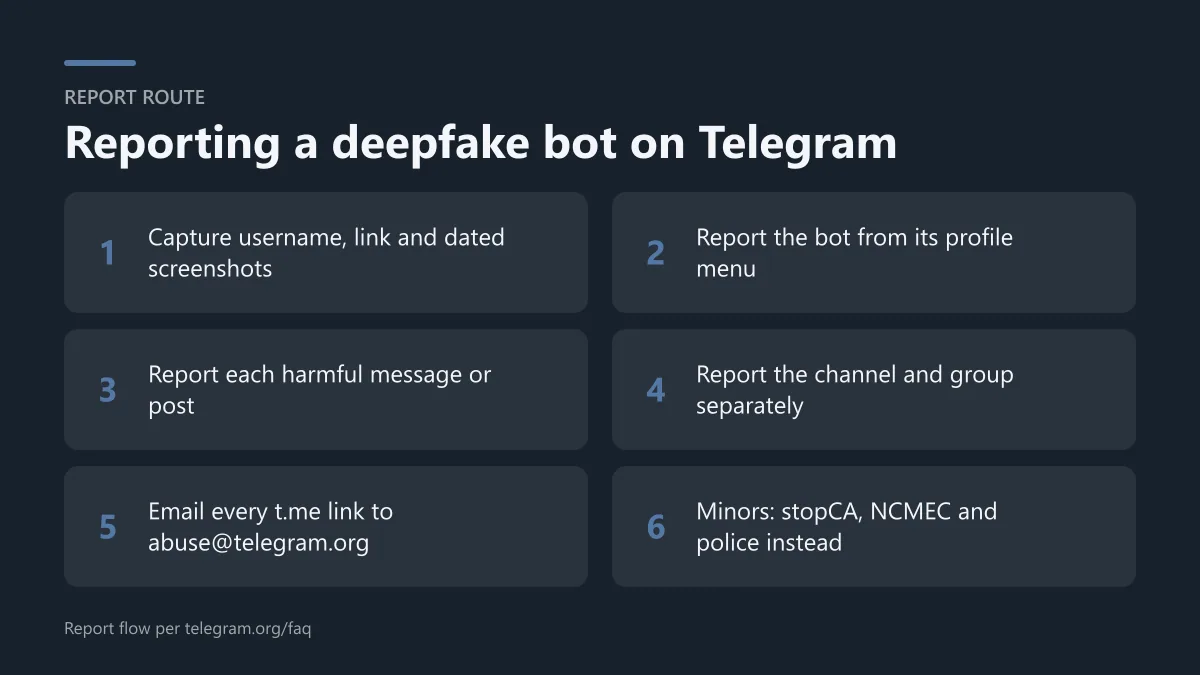
Save the proof first, then use Report inside the app, then email the links to Telegram's abuse address.
Order matters here. Blocking the bot or deleting the chat can wipe its replies from your side, and those replies are your proof. Every Telegram app has a Report button, according to the illegal-content answer in Telegram's FAQ. The gesture depends on the device. Android opens the menu with a tap, iOS with a long hold, and Desktop or macOS with a right-click. Whichever you use, the menu then offers Report and a list of reasons.
- Capture. Copy the bot's @username and t.me link. Take screenshots that show the username, the date and the reply in one frame.
- Report the bot. Go to the bot's profile and pick Report from its menu. Pick the reason closest to the harm and add a one-line note on what it produces.
- Report single messages. Press on each harmful reply or post, choose Report and give the same reason.
- Report the channel and any group. Treat each as its own target, with its own screenshots.
- Email abuse@telegram.org. List one t.me link per line and say what each one shows. Telegram's FAQ asks for links like these in every email takedown request.
- Add the EU form if you live in the EU. Telegram's EU user guidance points to its illegal-content form, which wants your name, a contact address and an explanation of why the material breaks the law.
- Switch routes for a minor. If anyone shown may be a child, go to the minors route in the next section instead.
A full walk-through for one message at a time sits in the guide on reporting a single Telegram message. If you would rather hand the filing over, Telegram Ban Service runs it as a Telegram report service, with the same routes and the same limits.
What should you save before reporting Telegram deepfake nudes?
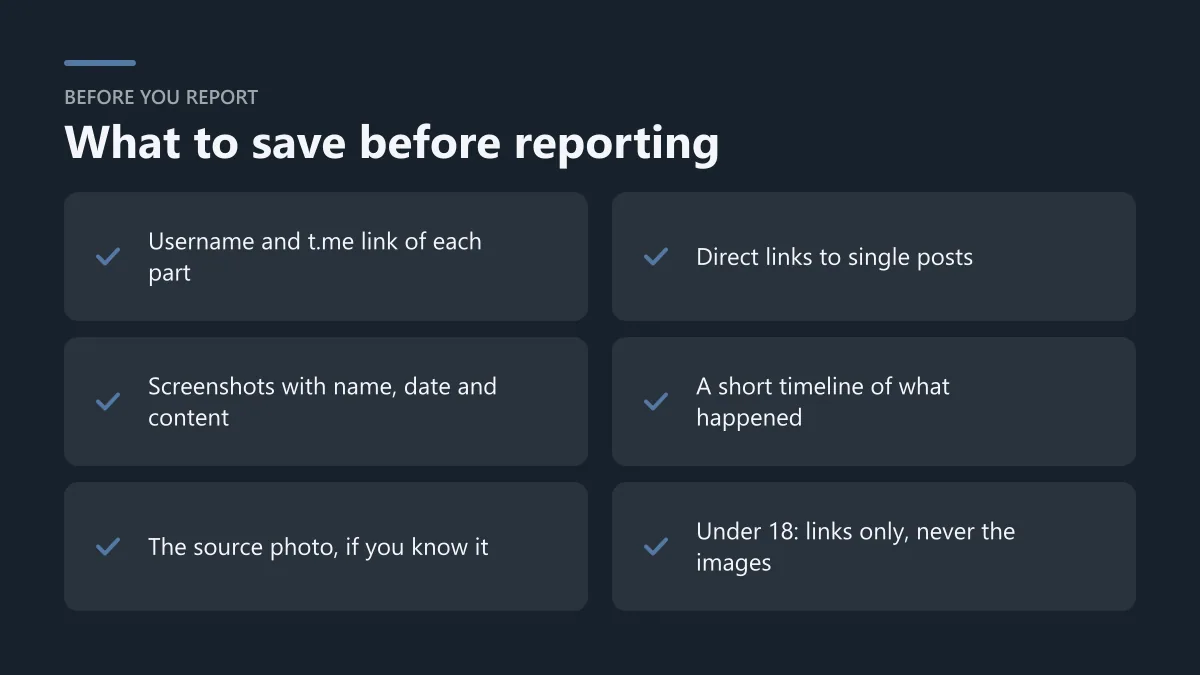
Save links, dated screenshots and a short timeline before you report Telegram deepfake nudes, because the chat may be gone once you act.
Moderators judge what they can open. A report with a working t.me link lets them see the bot or post right away. A cropped screenshot without a username gives them little to check. Keep the files outside the app, in a folder on a computer, so a phone cleanup cannot erase them.
One rule overrides everything else. If anyone in the images may be under 18, do not screenshot, download or forward them. Write down the links and use the minors route that NCMEC's Take It Down service and Telegram's stopCA@telegram.org address exist for.
- The @username and t.me link of every bot, channel and group involved
- Direct links to single posts, copied from each post's menu
- Screenshots that show the username, the date and the content together
- A short timeline: when you found it, who sent it, what changed
- The original photo the fake was made from, if you know it
- Any payment page address, without paying for anything
Reports also fail for plain reasons. Some name the bot but give no link. Others say "this is fake" without saying who is shown and that this person never agreed. A third kind reports the bot and forgets the channel that keeps replacing it.
What happens after a report, and does the law help?
After a report, Telegram's moderators review it and decide, and Telegram's FAQ names no time limit for that review.
The rules are on your side. Telegram's Terms of Service forbid posting illegal porn where the public can see it, and they name bots as well as channels. Its EU guidance goes further and lists non-consensual publication of sexual material among the things it never allows. Quote that rule in the email, next to the links.
Removal happens at scale. As of 20 November 2026, Telegram's safety page counted 30,632,909 groups and channels blocked during the year. Of those, 499,252 were tied to child sexual abuse material. The same page says Telegram added hashes from groups like the Internet Watch Foundation to its matching database in 2024.
Your report is one input among many. Telegram reported 7,700 moderation decisions for September 2026 to the DSA Transparency Database run by the EU. Just 143 of them, roughly 1.9%, came from a formal user notice. Those figures were read on 6 October 2026, and the rest began with Telegram's own detection.
Which laws back a Telegram deepfake report?
U.S. enforcement of the TAKE IT DOWN Act began on 19 May 2026, with the FTC in charge. A covered platform that receives a valid request has 48 hours to remove the intimate image and known copies of it. AI-made images count. Civil penalties reach $53,088 per violation. Whether a given app counts as a covered platform is for the FTC and the courts to judge.
Hashing helps beyond Telegram. StopNCII turns the image into a hash, a short code made on your phone. The picture stays with you, and member platforms receive just the code. Its partner list, checked on 25 September 2026, did not include Telegram. Use it anyway to slow copies on Facebook, Instagram and the other members.
What if the bot comes back under a new name?
A deepfake bot Telegram has banned can return the next day under a new handle. File again, and attach the earlier case: old links, dates and the new username. A pattern reads differently from a fresh complaint. Keep reporting the Telegram deepfake channel that posts each replacement, since it outlasts every deep fake bot Telegram removes. Piling on more reports of the same thing does not decide a ban, and the guide on report counts and channel bans covers why.
Why is there no Telegram deepfake bots list on this page?
No Telegram deepfake bots list appears on this page, because a list of working bots is free advertising for them.
Pages that rank these tools, or promise a Telegram deepfake bot free of charge, send traffic and sign-ups their way. Telegram Ban Service does not name working bots, link them or test them. Brand names that circulate, such as ClothOff Telegram copies, get reported and never reviewed. A Telegram deepfake is judged by the harm to the person shown, not by the tool's features.
The service also turns down three kinds of request, each for a reason:
- False reports. Nobody who has broken no rule gets reported. The guide on trying to get someone banned on Telegram explains why a false report fails and can backfire.
- Report floods. Sellers of a Telegram mass report bot promise volume, but volume is not the test. The same sellers push other platforms too, as shown in the review of WhatsApp mass report bot offers sold on Telegram and the look at what Instagram mass report buyers receive.
- Fake evidence. No fake image is created, requested or forwarded as proof. That would add to the harm the report is trying to stop.
What if the fake image spreads beyond Telegram?
When a fake image spreads beyond Telegram, each platform it reaches becomes a separate case, judged under that platform's own policy.
A copy on Facebook goes through Meta's routes, which the guide to Facebook post removal and its official routes lays out. A copy passed around in chats follows WhatsApp's own rules, and the page on what a WhatsApp ban service can and cannot do covers that side. If the fake arrives with a demand for money, treat it as extortion first and follow the steps for Telegram extortion threats. If the source photo is your own work, the Telegram DMCA takedown route can apply as well.
A harassment campaign can also hit a person's work. A doctor can face invented reviews, and the guide to Healthgrades review removal covers that site and its peers. A host can face the same on Airbnb, where removing an Airbnb review follows Airbnb's policy. A seller can face it on SellAuth, which has its own marketplace review rules. The playbook for fixing negative reviews sets out the order to work in.
Sources
- Telegram Terms of Service
- Telegram's guidance for EU users under the DSA
- Telegram FAQ, illegal content answer
- Telegram safety overview and blocking counters
- EU DSA Transparency Database
- FTC guidance on TAKE IT DOWN Act enforcement
- StopNCII image hashing
- NCMEC Take It Down
FAQ
Is it illegal to run a deep fake AI Telegram bot on someone's photo?
It can be. Which laws apply turns on the countries where you and the person shown live. Telegram's own rules already forbid it. Its Terms of Service forbid illegal sexual content that the public can view, bots included, and its EU guidance lists non-consensual sexual material among the things it never allows. So a Telegram AI deepfake of a real person breaks the platform's rules whatever local law says. Separate laws on making or sharing such images exist in a number of countries, and they differ in scope. In the U.S., the TAKE IT DOWN Act sets a short removal deadline that covered platforms must meet for intimate images, AI-made ones included; the FTC's enforcement guidance sets out the details. A lawyer in your country can say how the local law reads. None of this needs your input to start a report: the rule break alone is enough.
Are ClothOff Telegram bots real, or just scams?
Both kinds turn up, and from the outside you cannot tell them apart. A bot using a well-known brand name can be the real service, a copy, or a trap built to take payments and photos. Telegram nudify bots can switch usernames at any time, so a name in an ad proves nothing about who runs the account. That uncertainty is one more reason not to try one. Uploading a photo of someone else hands it to an operator you know nothing about. For a report, the brand does not matter. A Telegram nudify bot is reported on what it does: it turns real people's photos into fake sexual images. Describe that, add the link and screenshots, and name the channel that advertises it. A nudify bot that claims a famous name gets the same treatment as one with no name at all. Telegram's moderators judge the behavior, and the label on the bot is not part of that test.
Is a Telegram deepfake bot free of risk for the person who uses it?
No. The person using one takes on several risks at once, and none of them shows up in the bot's ads. First, the photo you upload goes to an unknown operator, who can keep it, sell it or use it again. Second, the output can break the law where you live, and saying it was only a test is no defense for the image itself. Third, Telegram deepfake bots break Telegram's rules, so the account using them can face limits too. Fourth, payment pages behind these bots can be scams in their own right. A Telegram undress bot sold as harmless fun still produces a sexual image of a real person who never agreed. That is also why this page offers no Telegram deepfake bots list and no trial links. The only service on offer here runs the other way: reporting these bots through Telegram's official routes, never using them.
What if a deep fake bot Telegram banned comes back under a new name?
Report the new account too, and connect it to the old case. A deepfake bot Telegram has removed once can reappear under a fresh handle. Replacement bots are part of how these operations work, so a returning handle is expected rather than a sign that reporting failed. Keep one folder with the first evidence and add each new username, link and date to it. When you file again, say that this is a returning operation and list the earlier handles. A pattern is easier for a moderator to act on than a fresh, isolated complaint. Then look for the part that stays the same. A deepfake Telegram channel that announces each new bot keeps its name and members. Report it as its own target, with its own post links. A deep fake Telegram bot can be rebuilt in minutes, but a channel with a large audience is much slower to replace. The channel is the piece worth the most attention.
Will Telegram tell you when a deepfake bot has been removed?
Telegram's FAQ does not describe any notice to the person who reported, so plan to check for yourself. Open the bot's t.me link every few days. If the account is gone or shows a restriction message, the report has had an effect. If nothing changes, file again with a stronger case rather than the same words. Add any new screenshots, the advertising channel and the links of every post that shows the harm. The steps for how to report a bot on Telegram are the easy part. The other half is a case a moderator can verify quickly: working links, clear dates and a plain statement of who is shown and that they did not consent. Keep reporting the related deepfake Telegram group as well, because group posts can keep the images moving after the bot is gone. Telegram alone decides on each report, and nobody can force a faster review.
Does StopNCII reach a Telegram deepfake channel?
Not directly. StopNCII converts your picture into a hash on your phone. The photo never leaves you, and member sites get only that code. On the partner list checked in September, Telegram was not one of those members. So hashing does not remove anything from a Telegram deepfake channel. It still helps: it can stop copies from being posted on the member platforms, which include Facebook, Instagram and other large sites, according to StopNCII's own site. Use both tracks on the same day. Hash the image with StopNCII to protect the platforms that take part. Then report the Telegram copy through the Report button and abuse@telegram.org. One more point: StopNCII is meant for adults. When the person shown is a child under 18, the matching tool is Take It Down from NCMEC, and Telegram's child safety address handles the Telegram side.
What should you do if the fake shows someone under 18?
Treat it as a child protection case from the first minute. Do not screenshot, download, save or forward the images, even as evidence, because keeping them can itself be a crime. Write down the t.me links and usernames instead. Then use three routes. Email stopCA@telegram.org with the links, which Telegram's safety page lists as one of its takedown addresses for child abuse material. Then turn to Take It Down, a free NCMEC tool that matches a code made from the image instead of the image itself. And contact your local police, who can open a case and act on the operator. Telegram deepfake nudes of a minor count as child sexual abuse material under Telegram's rules, which allow no exceptions for it. Parents and teachers can make these reports on a child's behalf. Telegram Ban Service does not handle the images in these cases.